





When NBA positions explained is what you are looking for, turning on a professional game can sometimes feel overwhelming. Today’s high-flying NBA superstars constantly cross up defenders, shoot from deep beyond the arc, and run transition plays at lightning speed. Yet, underneath the highlight-reel dunks and tactical rotations, every team relies on a standard system of five distinct positions. Whether you are building a fantasy roster, picking a player in a video game, or trying to follow the tactical chess match of an NBA broadcast, understanding how these individual roles operate is the foundation for appreciating the world’s premier basketball league.
Understanding the standard roster roles in the NBA
While early basketball relied strictly on set physical traits for each spot on the floor, the modern NBA has elevated these foundational concepts into dynamic roles. To make sense of how an NBA lineup functions, we can break the five starting positions down into their core responsibilities, key physical attributes, and court assignments.
The backcourt: Point guard (1) and shooting guard (2)
The backcourt consists of the primary ball-handlers and perimeter playmakers who orchestrate the team’s offensive rhythm from outside the three-point line.
- Point Guard (1): Frequently referred to as the floor general, the point guard directs plays, dictates tempo, and reads the opposing defense. They must possess elite court vision, exceptional ball-handling, and quick decision-making under heavy pressure. Historic stars like Magic Johnson and Steph Curry demonstrate how dominant point guards can transform an entire franchise’s offensive style.
- Shooting Guard (2): Traditionally the team’s premier perimeter scorer, the shooting guard excels at creating space, coming off screens, and knocking down mid-range or three-point shots. On defense, they are often tasked with containing the opponent’s most dangerous perimeter threat. Legends like Michael Jordan and Kobe Bryant defined the classic shooting guard archetype through high-volume scoring and perimeter defense.
The frontcourt: Small forward (3) and power forward (4)
Forwards connect the perimeter guards with the interior big men, bringing a crucial balance of athletic versatility, scoring punch, and rebounding.
- Small Forward (3): Often considered the most versatile position on an NBA floor, the small forward must combine wing scoring, physical defense, and rebounding ability. They regularly switch onto both smaller guards and larger forwards on defense while acting as secondary playmakers on offense. All-time greats like LeBron James and Kevin Durant illustrate how small forwards can dictate every facet of an NBA game.
- Power Forward (4): Positioned closer to the paint, the power forward provides toughness, screen-setting, and interior scoring. Modern NBA power forwards, however, are also required to stretch the defense by hitting perimeter jumpers while competing fiercely for contested rebounds against opponent big men.
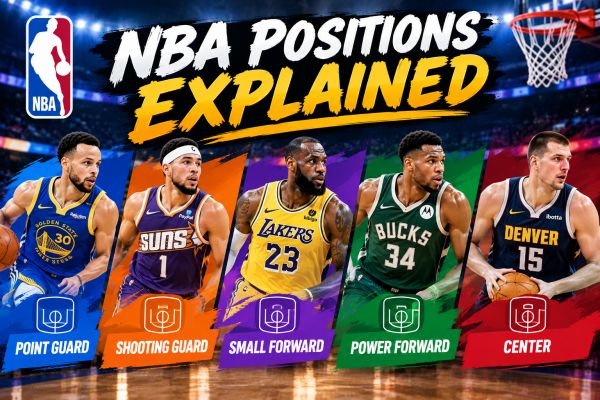
NBA positions explained
The center (5): Anchor of the defense and paint
The center is traditionally the tallest player on an NBA roster, stationed near the basket to control the painted area on both ends of the floor.
- Rim Protection and Rebounding: Defensively, the center serves as the anchor, blocking shots, altering driving layups, and securing defensive rebounds to seal possessions. Offensively, they roll to the rim off pick-and-rolls, score on put-backs, and set physical screens to free up perimeter shooters.
- The Modern Evolution: While classic centers like Shaquille O’Neal dominated through physical strength near the rim, modern NBA centers are increasingly valued for their passing skills out of the post and their ability to shoot three-pointers, pulling enemy defenders away from the basket.
The rise of positionless basketball in the modern NBA
If you watch today’s NBA games, you will notice that rigid positional boundaries are shifting. Modern coaching strategies heavily emphasize “positionless basketball”—a concept where players of all sizes possess guard-like ball skills and center-like length.
In today’s league, a 6-foot-11 player might run the offense as the primary ball-handler, while a shorter team might play without a traditional center altogether. Rather than rendering traditional positions obsolete, this evolution makes understanding the baseline roles even more valuable. Recognizing how players bend these traditional positions helps you appreciate the tactical genius and athleticism required to succeed in the modern NBA.
Conclusion
Having NBA positions explained simply helps break down the fast-paced chaos of a professional basketball game into clear, strategic components. While today’s superstars continue to push positional boundaries with unique skill sets, the five core roles remain the baseline blueprint for how NBA teams build their rosters and run their schemes. The next time you watch a game, keeping these roles in mind will give you a much deeper insight into every pass, pick, and defensive switch on the court.
Related Posts
Basketball Rules Explained: A Beginner’s Guide
When you want basketball rules explained without wading through a dense rulebook, watching a fast-paced game on television can feel confusing. With players sprinting back and forth, the constant squeak of sneakers, and whistles blowing seemingly every minute, it is easy to feel lost. However, beneath the high-energy action, basketball is governed by a clear, […]
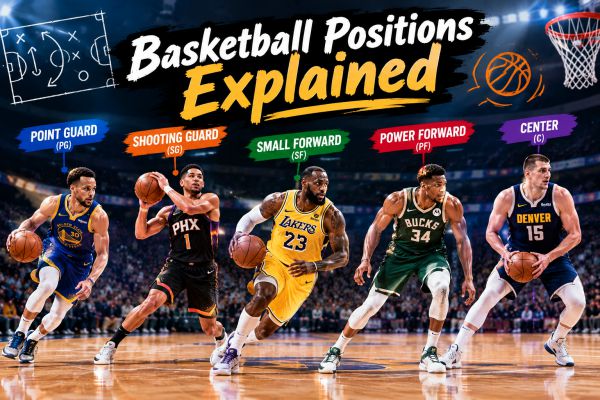
Basketball Positions Explained: Simple Court Roles
When basketball positions explained is what you are looking for, watching a game for the first time can still feel a bit overwhelming. Players move fluidly across the hardwood, passing, shooting, and switching assignments in a matter of seconds. However, underneath the fast-paced action, basketball is built on a foundation of five distinct positions. Whether […]

Basketball Shoes Of 2026: Innovations And Performance Standards
Exploring the Basketball Shoes of 2026 reveals a transformative era in sports footwear engineering. This year’s landscape is defined by major advancements in nitrogen-infused foam chemistry, generative 3D foot-mapping traction patterns, and carbon-composite propulsion plates. Whether you are a lightning-fast perimeter playmaker looking for zero-lag responsiveness or a powerhouse center needing max-volume impact protection, the […]
NBA Basketball Shoes: Pro Performance & Fit Guide
Selecting authentic NBA basketball shoes means investing in the absolute highest tier of sports footwear engineering available. Every night on the professional hardwood, elite athletes push their equipment to absolute limits—executing violent deceleration stops, explosive vertical takeoffs, and high-velocity lateral cuts. Because professional players generate immense biomechanical forces, footwear designed for this level must deliver […]