





When you want basketball rules explained without wading through a dense rulebook, watching a fast-paced game on television can feel confusing. With players sprinting back and forth, the constant squeak of sneakers, and whistles blowing seemingly every minute, it is easy to feel lost. However, beneath the high-energy action, basketball is governed by a clear, logical set of regulations designed to keep the game fair, safe, and flowing. Whether you are trying to understand a live match, preparing to play in a casual pick-up game, or helping a child learn the sport, mastering the basic principles transforms confusion into genuine excitement.
Understanding the core regulations of the game
To truly enjoy or participate in basketball, you do not need to memorize every technicality in the official referee handbook. Instead, you can grasp the essence of the game by understanding how it is scored, how players move legally with the ball, what physical contact is restricted, and how the game is timed. These foundational pillars form the structure of every basketball match played around the world.
Scoring and basic game flow
At its heart, basketball is a contest of putting the ball through the opponent’s hoop while preventing them from doing the same. A standard game is divided into quarters or halves, with the clock stopping every time the whistle blows.
- How Points Are Scored: Shots taken from inside the three-point arc count for two points. Any successful field goal shot from beyond the three-point line awards three points. Additionally, successful free throws—awarded after certain fouls—are worth one point each.
- Moving the Ball: Players cannot simply run while holding the ball; they must bounce it against the floor, a technique known as dribbling. Once a player stops dribbling and holds the ball with both hands, they must either pass or shoot; they cannot start dribbling again.
Common violations: Traveling and double dribble
Violations occur when a player breaks the rules regarding ball movement or court boundaries. While they do not result in free throws for the opposing team, they do result in a turnover, meaning possession is handed over to the other side.
- Traveling: This happens when a player takes too many steps without dribbling the ball—typically more than two steps after catching it or ending a dribble.
- Double Dribble: A player commits a double dribble if they stop dribbling, pick up the ball, and then start dribbling again, or if they dribble with both hands simultaneously. Recognizing these two frequent infractions makes it much easier to follow why the referee’s whistle just blew.
Basketball rules explained
Fouls: Personal, technical, and team fouls
Unlike violations, fouls involve illegal physical contact or unsportsmanlike behavior. Basketball is officially a non-contact sport, though a certain amount of physical jostling is natural during intense play.
- Personal Fouls: These involve illegal physical contact with an opponent, such as pushing, holding, hacking an arm during a shot, or blocking a player’s path illegally. If a player commits a shooting foul, the fouled player gets free throws. Players are typically disqualified (foul out) after committing five or six personal fouls, depending on the league.
- Technical Fouls: These are non-contact infractions related to conduct, such as arguing aggressively with referees, using inappropriate language, or delay-of-game tactics. They result in free-throw opportunities for the opposing team.
Time restrictions: The shot clock and game limits
Basketball is designed to be an exceptionally fast game, meaning players are not allowed to stall or waste time deliberately.
- The Shot Clock: In professional and organized leagues, the offensive team has a limited amount of time—typically 24 seconds—from the moment they gain possession to attempt a shot that touches the rim. If the clock runs out before the ball hits the rim, a shot-clock violation is called, and the ball goes to the defense.
- Quarter and Half Limits: Games are split into four quarters (in NBA and FIBA rules) or two halves (in college basketball), interspersed with breaks to let players rest and coaches adjust strategies.
Conclusion
Getting basketball rules explained clearly helps lift the mystery behind the fast breaks, whistles, and scoreboard changes. While professional rulebooks are filled with nuance and fine print, the everyday reality of the game rests on straightforward concepts: dribbling legally, scoring points from different distances, avoiding physical fouls, and respecting the clock. Whether you are following your favorite team or stepping onto the court yourself, knowing these core basics lets you focus on what truly matters—the skill, teamwork, and excitement of the game.
Related Posts
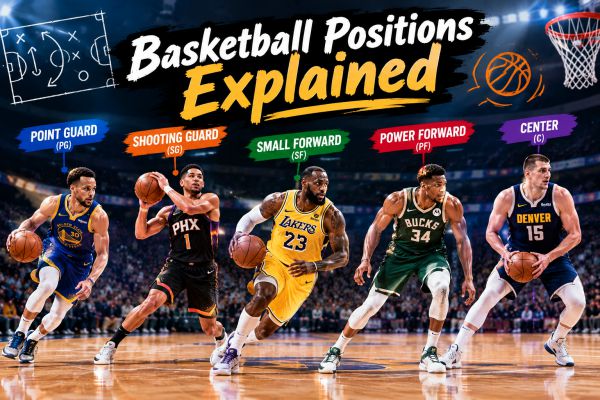
Basketball Positions Explained: Simple Court Roles
When basketball positions explained is what you are looking for, watching a game for the first time can still feel a bit overwhelming. Players move fluidly across the hardwood, passing, shooting, and switching assignments in a matter of seconds. However, underneath the fast-paced action, basketball is built on a foundation of five distinct positions. Whether […]
Basketball Shoes Of 2026: Innovations And Performance Standards
Exploring the Basketball Shoes of 2026 reveals a transformative era in sports footwear engineering. This year’s landscape is defined by major advancements in nitrogen-infused foam chemistry, generative 3D foot-mapping traction patterns, and carbon-composite propulsion plates. Whether you are a lightning-fast perimeter playmaker looking for zero-lag responsiveness or a powerhouse center needing max-volume impact protection, the […]
NBA Basketball Shoes: Pro Performance & Fit Guide
Selecting authentic NBA basketball shoes means investing in the absolute highest tier of sports footwear engineering available. Every night on the professional hardwood, elite athletes push their equipment to absolute limits—executing violent deceleration stops, explosive vertical takeoffs, and high-velocity lateral cuts. Because professional players generate immense biomechanical forces, footwear designed for this level must deliver […]
New Basketball Shoes: Cutting-Edge Tech and Selection Guide
Finding the right pair of New Basketball Shoes means stepping into the latest advancements in sports performance engineering. Every season, major footwear brands push the boundaries of materials, foam chemistry, and traction designs. Whether it is nitrogen-infused midsoles, carbon-fiber propulsion plates, or generative 3D-mapped tread patterns, the newest releases are crafted to help players move […]