





Choosing between Basketball Shoes vs Training Shoes is a common point of confusion for athletes and gym-goers alike. At first glance, both sneaker categories appear to offer supportive uppers, cushioned midsoles, and durable outsoles designed for athletic movements. However, basketball shoes and cross-training shoes are engineered for entirely different physical demands, biomechanics, and surface interactions. Wearing the wrong pair for your specific activity can compromise your performance and increase your risk of injury.
In this detailed performance comparison, we will break down Basketball Shoes vs Training Shoes across all key factors so you can select the perfect footwear for your training regimen.
Detailed performance comparison: Basketball shoes vs training shoes
To help you decide which shoe belongs in your gym bag, let’s examine how both categories differ in activity compatibility, cushioning, traction, fit, and durability.
Which activity fits each shoe category?
Understanding the primary design purpose of each shoe type helps clarify where they excel and where they fall short.
- Basketball Shoes: Specifically engineered for dynamic, high-impact court sports involving continuous jumping, abrupt lateral cuts, heavy landings, and rapid acceleration. They feature higher ankle collars or reinforced lateral containment structures to handle aggressive multi-directional footwork on polished hardwood or outdoor courts.
- Training Shoes (Cross-Trainers): Built for versatility across gym-based workouts, including weightlifting, HIIT sessions, short treadmill runs, plyometrics, and calisthenics. They prioritize a flat, stable platform for lifting heavy weights while remaining flexible enough for quick agility drills and short cardiovascular bursts.
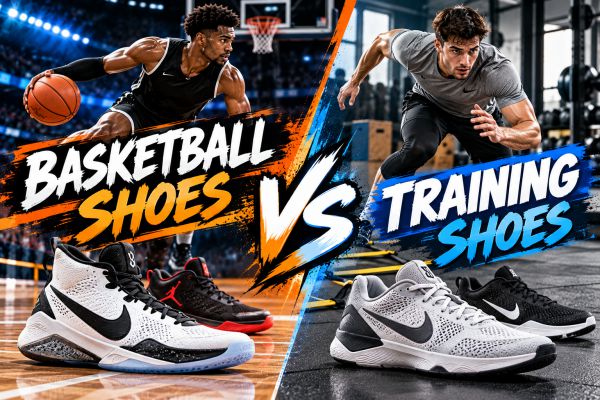
Basketball Shoes vs Training Shoes
Key differences in cushioning and traction
The underfoot construction reveals the biggest functional differences between basketball sneakers and gym training shoes.
- Cushioning:
- Basketball Shoes: Feature thick, highly shock-absorbent cushioning systems (such as Nike Zoom Air, Adidas Boost, or Puma Nitro Foam). This setup absorbs intense impact forces when landing from vertical jumps and provides springy energy return for explosive court movements.
- Training Shoes: Utilize firmer, lower-profile foam midsoles with minimal heel-to-toe drop. This flatter platform minimizes energy absorption during squats, deadlifts, and lunges, giving you a solid, grounded base to push force directly into the floor.
- Traction:
- Basketball Shoes: Feature aggressive, multi-directional tread patterns (like herringbone) made to grip smooth indoor court surfaces or outdoor concrete for sharp, slip-free stops.
- Training Shoes: Feature flatter, broader outsoles with flex grooves and rubber wraps extending up the medial sidewall for rope climbs and lateral balance rather than high-friction stopping power.
Fit and surface durability
Fit dynamics and outsole materials vary significantly depending on whether you are on the basketball court or the gym floor.
- Fit & Support:
- Basketball Shoes: Offer a tight, locked-in fit with rigid heel counters and TPU side-walls to prevent ankle roll during high-speed direction changes.
- Training Shoes: Focus on a wider, anatomical toe box that allows your toes to splay naturally for balance during heavy lifts, while providing a snug fit around the midfoot.
- Surface Durability:
- Basketball shoe outsoles wear down quickly if used extensively on abrasive gym turf or rubberized lifting platforms.
- Training shoe outsoles are built with durable, abrasion-resistant rubber designed to withstand indoor gym flooring, turf, and pavement without losing stability.
Conclusion
When deciding between Basketball Shoes vs Training Shoes, your choice comes down to the primary movement patterns of your workouts. If your routines revolve around basketball games, vertical jumping drills, and high-impact lateral agility on the court, basketball shoes provide the necessary impact protection, lockdown, and ankle stability. Conversely, if your goal is general gym fitness, heavy weightlifting, cross-training, or HIIT workouts, dedicated training shoes offer the flat stability, toe splay, and heel firmness required for safe, efficient lifting. Choosing the shoe designed specifically for your surface and sport ensures optimal performance and keeps you injury-free.
Related Posts
Nike GT Cut vs Nike Sabrina: How Do They Perform On Court?
Choosing between Nike GT Cut vs Nike Sabrina is a common dilemma for basketball players searching for the ultimate low-cut performance sneaker. Both signature and performance lines from Nike are built specifically with quick, agile hoopers in mind, offering exceptional court feel, lightweight support, and top-tier traction. However, while both shoes share a focus on […]

Nike Basketball Shoes vs Adidas Basketball Shoes: Which Brand Better Fits Your Game?
Choosing between Nike basketball shoes vs Adidas basketball shoes remains one of the most classic debates on the basketball court. Both sportswear giants dominate the market, boasting world-class athlete rosters, cutting-edge technologies, and performance lineups tailored to players of all skill levels. However, while both brands deliver top-tier performance, their underlying engineering philosophies, cushioning setups, […]

Anthony Edwards Shoes vs Ja Morant Shoes: Which On-Court Performance Suits You Best?
Choosing between Anthony Edwards Shoes vs Ja Morant Shoes is one of the toughest decisions for basketball players today. Both signature lines offer cutting-edge designs, top-tier performance, and accessible price points backed by two of the NBA’s most exciting superstars. However, while both sneakers deliver high-level performance, their on-court feel, cushioning, and stability cater to […]
Basketball Man-to-Man Defense Explained: Core Blueprint
When basketball man-to-man defense explained becomes your focus for decoding professional and amateur game strategies, you dive into the heartbeat of competitive basketball. Unlike zone defenses that protect static spatial regions on the hardwood, man-to-man defense is built on absolute individual accountability fused with synchronized team coordination. Every single defender is handed a direct assignment: […]