





When basketball traveling explained is what you need to make sense of court action, seeing a referee suddenly stop a fast break to roll their hands over each other can leave both players and fans scratching their heads. Traveling is one of the most frequently called violations in basketball, yet it remains one of the most misunderstood. With the modern game evolving to include complex footwork like step-backs, euro-steps, and hop-gathers, the boundary between a brilliant basketball move and an illegal walk can seem blurry. Understanding the core mechanics of traveling, how the pivot foot works, and what referees look for will clarify the game and elevate your own play on the floor.
Understanding the mechanics of the traveling violation
At its core, basketball requires players to continuously bounce the ball while moving across the court. Traveling occurs when a player holding the ball moves one or both feet illegally without dribbling first. Instead of resulting in free throws, a traveling call is a turnover, handing immediate possession of the ball over to the opposing team.
The pivot foot foundation
The concept of the pivot foot is the absolute bedrock of basketball footwork and legal movement.
- Establishing a pivot foot: When a player receives a pass or stops dribbling, the foot that remains in contact with the floor becomes their pivot foot. If a player catches the ball while standing with both feet on the floor, they can choose either foot as their pivot foot.
- Legal movement: A player may lift their pivot foot to jump, shoot, or pass, but the ball must leave their hands before the pivot foot returns to the floor. If a player lifts their pivot foot and puts it back down while still holding the ball, a traveling violation is instantly called.
The gather step and modern footwork
In today’s fast-paced game, understanding the “gather step” is essential to distinguishing legal moves from traveling violations.
- What is a gather step? The gather occurs when a player gains complete control of the ball after ending a dribble or receiving a pass while on the move. The step taken during or immediately after this moment is counted as step zero (the gather step).
- Executing legal moves: After the gather step, a player is legally allowed up to two additional steps to come to a stop, pass, or shoot. This rule allows for dynamic moves like the euro-step or the step-back jumper without violating movement restrictions.
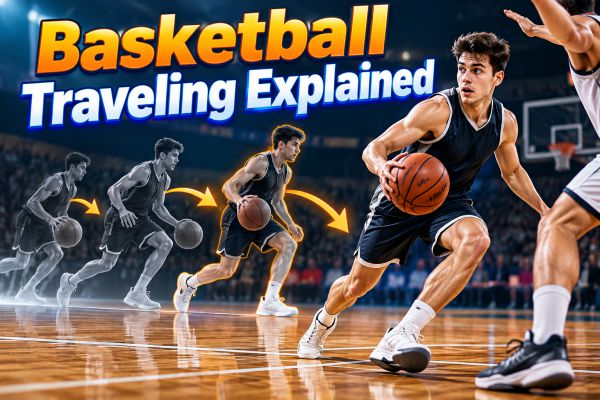
Basketball traveling explained
Common traveling mistakes on the court
Even experienced players commit traveling violations when fundamental footwork breaks down under defensive pressure.
- Moving before the dribble: A very common mistake happens when a player standing still decides to drive toward the basket. If they lift their pivot foot before the ball leaves their hand to start a dribble, it is an automatic travel.
- Shuffling and sliding: Shuffling or dragging the pivot foot across the hardwood while looking for an open pass or waiting for a screen is another frequent cause for a whistle.
- Falling or rising with the ball: If a player falls to the floor while holding the ball, or slides across the court without dribbling, it is traveling. Similarly, jumping up to shoot or pass and coming back down to the floor still holding the ball (an “up-and-down”) results in a turnover.
How to avoid traveling during live play
Developing clean footwork habits is the best way to eliminate traveling calls from your game.
- Mastering the triple-threat stance: Practicing a balanced stance upon catching the ball gives you full control over your pivot foot while keeping passing, shooting, and driving options open.
- Timing the first dribble: Focus on pushing the ball down to the floor a fraction of a second before lifting your back foot when starting a drive.
- Sharpening body control: Practicing controlled two-foot jump stops helps you land firmly, avoid momentum-driven extra steps, and maintain balance against physical defense.
Conclusion
Having basketball traveling explained clearly strips away the confusion behind one of the sport’s most essential rules. From basic pivot foot control to executing precise gather steps, mastering legal footwork is fundamental to keeping possession and scoring efficiently. Whether you are analyzing elite step-backs on TV or sharpening your skills for pick-up games, a clear grasp of traveling rules lets you appreciate the artistry of great footwork on the court.
Related Posts
Basketball Fouls Explained: A Simple Court Guide
When basketball fouls explained is what you need to make sense of a game, watching the referee suddenly blow the whistle and make dramatic hand signals can feel confusing. Players throw their hands up in protest, coaches shout from the sidelines, and free-throw shooting begins. Physical contact is an inevitable part of a fast-paced sport […]
NBA Positions Explained: The 5 On-Court Roles
When NBA positions explained is what you are looking for, turning on a professional game can sometimes feel overwhelming. Today’s high-flying NBA superstars constantly cross up defenders, shoot from deep beyond the arc, and run transition plays at lightning speed. Yet, underneath the highlight-reel dunks and tactical rotations, every team relies on a standard system […]
Basketball Rules Explained: A Beginner’s Guide
When you want basketball rules explained without wading through a dense rulebook, watching a fast-paced game on television can feel confusing. With players sprinting back and forth, the constant squeak of sneakers, and whistles blowing seemingly every minute, it is easy to feel lost. However, beneath the high-energy action, basketball is governed by a clear, […]
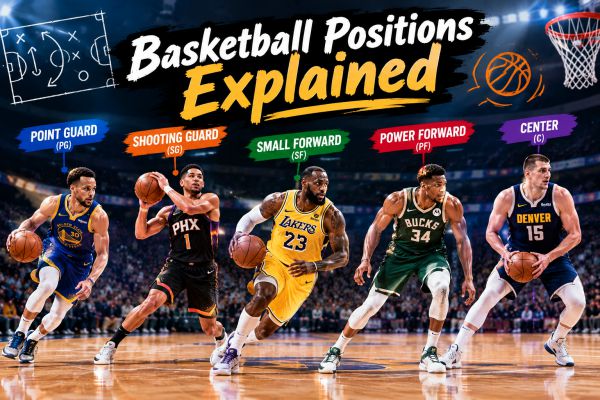
Basketball Positions Explained: Simple Court Roles
When basketball positions explained is what you are looking for, watching a game for the first time can still feel a bit overwhelming. Players move fluidly across the hardwood, passing, shooting, and switching assignments in a matter of seconds. However, underneath the fast-paced action, basketball is built on a foundation of five distinct positions. Whether […]