




Understanding how to choose basketball shoes for quick guards is one of the most effective ways to upgrade your court agility and responsiveness. Point guards and shooting guards rely on rapid acceleration, sharp crossovers, and sudden deceleration to create space and beat defenders.
When you wear footwear with an overly thick midsole or sloppy internal fit, energy is absorbed during the compression phase. This minor delay—often called “energy lag”—can cost a fraction of a second, deciding whether you blow past a defender or get stripped on the drive. Quick guards require a low-to-the-ground setup that combines biting traction with rigid lateral containment.
To help you eliminate energy loss and choose footwear that matches your footwork, this comprehensive guide covers the biomechanics of high-speed play, essential evaluation criteria, playstyle-specific features, and practical fitting advice.
Step-by-step criteria to evaluate high-speed guard footwear
Analyzing the biomechanical needs of high-velocity playmakers
The footwork of a modern quick guard creates unique physical demands that standard running shoes or heavy post footwear cannot accommodate:
- Acute takeoff angles: When initiating a drive or blowing past a defender, guards push off the lateral edge of their forefoot at a sharp angle. A low-profile forefoot midsole minimizes energy absorption, ensuring instant propulsion.
- High-deceleration forces: Stopping abruptly for a pull-up jumper or step-back shot exerts massive forward force. The shoe must grip the floor instantly without allowing the foot to slide forward inside the toe box.
- Rapid lateral direction changes: Changing direction at top speed generates heavy side-to-side torque. Without a wide base and lateral support, the foot risks sliding off the footbed, causing energy loss or ankle rolls.
Evaluating the four core technical pillars of quick guard shoes
When learning how to choose basketball shoes for quick guards, evaluate prospective models against these four mandatory engineering criteria:
- Low-stack cushioning with lively energy return
Prioritize thin, firm, and responsive cushioning setups—such as full-length Zoom Strobel, supercritical nitrogen-infused foams (Li-Ning Boom, Puma Nitro), or low-profile dual-density midsoles. These systems keep your feet close to the floor, maximizing court feel and agility. - Tacky, multi-directional tread patterns
Quick guards demand outsoles that bite instantly on both clean and dusty courts. Look for deep herringbone, radial, or generative tread patterns using soft, pliable rubber compounds that produce an audible squeak and stopping grip. - Rigid midfoot shank plates
A stiff carbon fiber or TPU shank plate embedded in the midfoot acts as a structural bridge. It stops the shoe from flexing unnaturally at the arch, providing a snappy transition from heel-strike to toe-off. - Prominent lateral outriggers and heel containment
An extended rubber outrigger near the pinky toe broadens the shoe’s footprint, keeping you stable during aggressive lateral cuts. Paired with a rigid internal heel counter, this ensures your rearfoot remains locked over the footbed.
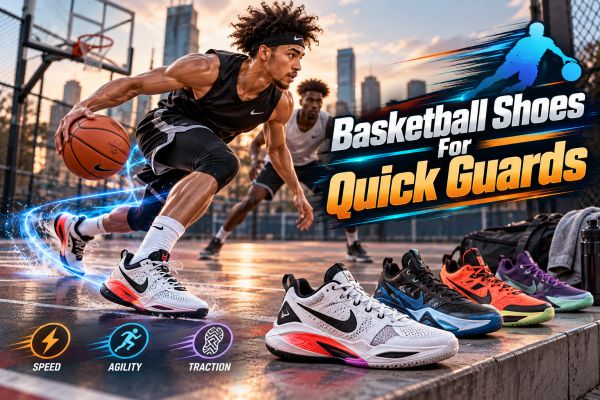
Basketball shoes for quick guards
Selecting shoe features based on your specific playing style
Not all guards play the same way. Matching specific shoe characteristics to your on-court role yields the best performance results:
- For downhill slashers and rim attackers (Maximum Bite & First-Step Snap)
- Focus: Ultra-low stack heights, springy forefoot units, aggressive toe-spring angles.
- Top Shoe Profiles: Low-profile speed performers—such as the Li-Ning Way of Wade 808 / Gamma series, Nike Sabrina series, or adidas Dame Certified line—deliver razor-sharp court feel and instant acceleration for direct drives.
- For crafty shot-creators and perimeter playmakers (Lateral Stability & Smooth Transitions)
- Focus: Curved heel geometry, broad forefoot platforms, rigid midfoot torsion plates.
- Top Shoe Profiles: Precision models like the Air Jordan main line, Nike Kobe / G.T. Cut series, or Puma All-Pro Nitro provide fluid heel-to-toe transitions and elite containment for step-backs and crossovers.
- For lock-down on-ball defenders (Durability & Unyielding Containment)
- Focus: Durable outsole rubber, reinforced upper overlays, deep heel cups.
- Top Shoe Profiles: Built-to-last options like the adidas Harden Vol. series, New Balance TWO WXY line, or Anta Shock Wave series offer reliable lateral containment and long-lasting grip for defensive slides.
Testing internal lockdown and fit during the fitting process
Even the most technologically advanced guard shoe will fail if internal foot movement compromises your reaction time:
- Aim for a true 1:1 fit: Guards should avoid wearing shoes with excess toe space. Aim for no more than an index finger’s width (roughly 0.5 cm) between your toes and the tip of the shoe. A snug fit eliminates internal sliding during hard stops.
- Use the runner’s loop (Heel-Lock Lacing): Utilize the top eyelet near the ankle collar to tie a heel-lock knot. This pulls your ankle backward into the padded heel pocket, anchoring your heel firmly against the footbed and preventing toe-jamming during sudden stops.
- Maintain clean outsoles during games: Dust reduces traction for quick guards. Habitually wipe your outsoles with a moist hand during breaks or timeouts to clear fine dust particles from the tread, maintaining maximum stopping power throughout the game.
Summary
Knowing how to choose basketball shoes for quick guards comes down to prioritizing court responsiveness over plush comfort. Look for sticky multi-directional traction, low-profile responsive midsoles, and rigid midfoot shank plates over heavy cushioning stacks. Selecting shoes engineered specifically for high-speed court feel and lockdown will eliminate energy lag, sharpen your cuts, and give you the confidence to control the tempo of every game.
Related Posts
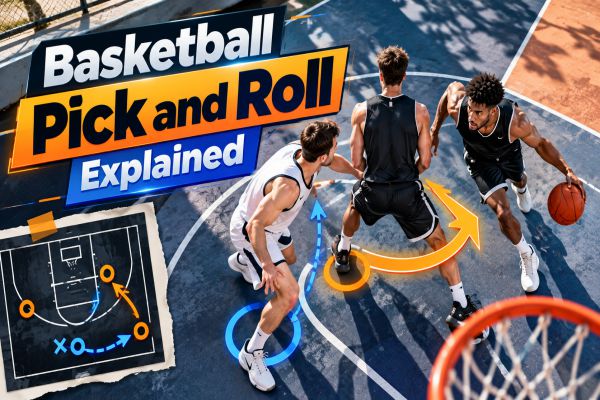
Basketball Pick and Roll Explained: The Ultimate Tactical Guide
When basketball pick and roll explained is what you are searching for, viewing it purely as a two-man drill on paper misses what actually makes it work. On the court, a pick and roll is not a set play with a guaranteed outcome; it is a dynamic reaction to how the defense responds. Whether you […]
Basketball Shot Clock Explained: Simple Rules & Timing
When basketball shot clock explained is what you need to keep up with the game, watching the small digital timer countdown above the backboard can add an extra layer of tension to every possession. The shot clock is one of the most important tactical elements in modern basketball, dictating the tempo of play and forcing […]
Basketball Goaltending Explained: Simple Rim Rules
When basketball goaltending explained is what you need to understand key court rulings, seeing a referee blow the whistle and award points for a shot that never went through the hoop can seem confusing. Blocked shots are among the most thrilling plays in basketball, electrifying fans and shifting game momentum. However, there is a fine […]
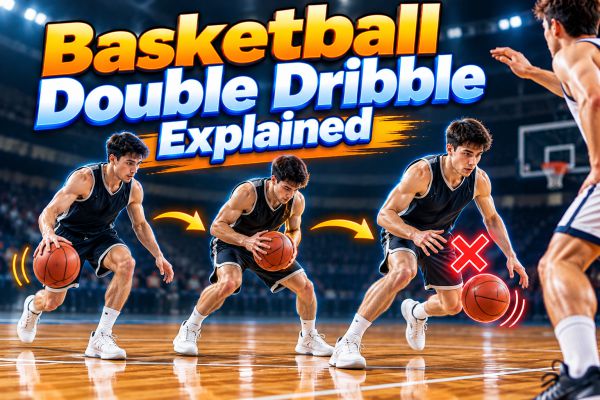
Basketball Double Dribble Explained: A Simple Rule Guide
When basketball double dribble explained is what you need to understand court violations, seeing a referee blow the whistle and pat their hands alternately up and down can leave new fans and players confused. Ball control is the core mechanic of basketball offense, and strict regulations dictate how a player can handle the basketball while […]