





Selecting the best basketball shoes for point guards is a tactical decision that directly influences your ability to control the tempo of a game. As the floor general, a point guard’s responsibilities demand constant directional shifts, sudden deceleration stops to set up plays, high-speed crossover drives, and relentless full-court defense.
When a point guard wears footwear with an overly thick or mushy midsole, kinetic energy is absorbed during the plant phase. This subtle lag can slow down your first step or compromise your balance during a jump pass. Point guards require a low-profile, responsive setup that delivers razor-sharp court feel, instantaneous stopping power, and absolute lateral containment.
To help you dictate the pace and optimize your footwork, this performance guide breaks down the biomechanics of point guard play, mandatory technical specifications, playstyle-matched shoe profiles, and practical fitting adjustments.
Floor general blueprint: Footwear mechanics for elite point guards
Biomechanical demands of tempo control and rapid court coverage
The footwork required of a modern point guard creates unique physical strains that standard footwear cannot accommodate:
- Instantaneous deceleration stopping: Point guards must stop on a dime to pull up for a jumper, make a sharp bounce pass, or change direction. Outsoles must bite the floor instantly without internal foot sliding.
- Acute takeoff and plant angles: Initiating a drive from a standstill requires pushing off the medial and lateral edges of the forefoot. A low-profile forefoot midsole minimizes energy loss, ensuring immediate forward momentum.
- Continuous high-mileage coverage: Point guards typically cover more distance per game than any other position. Footwear must balance lightweight agility with sufficient arch support to prevent late-game foot fatigue.
Essential technical specs required for floor general performance
Before choosing your next pair of basketball shoes, evaluate prospective models against four core engineering benchmarks tailored for point guards:
- Low-stack cushioning with snappy energy return
Prioritize low-profile, responsive cushioning setups—such as full-length Zoom Strobel, supercritical nitrogen-infused foams (Li-Ning Boom, Puma Nitro), or low-density foam cores. Keeping your foot close to the court maximizes sensory feedback and agility. - Aggressive, multi-directional tread patterns
Floor generals demand outsoles that grip cleanly on both polished wood and dusty surfaces. Look for deep herringbone, radial, or generative tread patterns using pliable rubber compounds that deliver consistent stopping bite. - Rigid midfoot shank plates
A stiff carbon fiber or TPU shank plate embedded in the midfoot prevents energy loss during foot flex. It acts as a structural bridge, ensuring smooth, springy transitions from heel-strike to toe-off during fast breaks. - Prominent lateral outriggers and heel cups
An extended rubber outrigger near the pinky toe broadens the shoe’s base footprint, keeping you stable during sharp cuts. Combined with a rigid internal heel counter, this locks your rearfoot securely over the footbed.
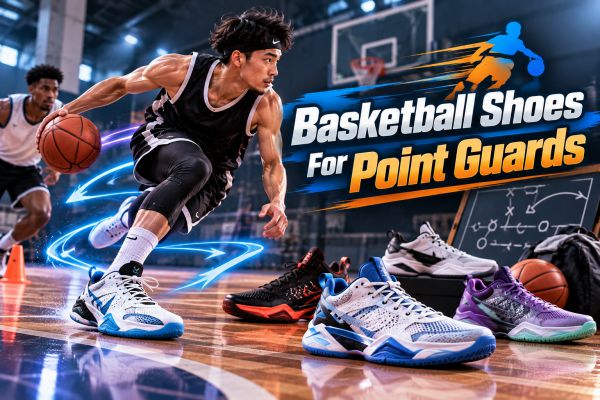
Basketball shoes for point guards
Matching shoe architectures to distinct point guard playstyles
When searching for the best basketball shoes for point guards, aligning the shoe’s structural build with your specific playstyle yields the best court results:
- For pure playmakers and pass-first floor generals (Court Feel & Smooth Transitions)
- Focus: Ultra-low stack heights, flexible forefoot uppers, smooth heel-to-toe curvature.
- Top Shoe Profiles: Precision models—such as the Nike Sabrina series, Li-Ning Way of Wade 808 line, or adidas Dame Certified series—deliver exceptional court control and fluid footwork for setting up teammates.
- For scoring point guards and explosive drivers (First-Step Snap & Bounce)
- Focus: Springy forefoot air/foam units, rigid carbon shank plates, aggressive traction angles.
- Top Shoe Profiles: Dynamic speed options—like the Air Jordan main line, Nike Kobe / G.T. Cut series, or Way of Wade main line—provide energetic launch response and elite containment for downhill scoring.
- For defensive floor generals and high-tempo pressers (Durability & Unyielding Lockdown)
- Focus: Durable solid rubber outsoles, broad base platforms, reinforced lateral overlays.
- Top Shoe Profiles: Built-to-last guard setups—such as the adidas Harden Vol. series, New Balance TWO WXY line, or Puma All-Pro Nitro—offer relentless lateral stability for sliding on defense and pressuring the ball.
Fit precision and outsole care to preserve split-second reaction times
Even the most advanced point guard shoe will fail if internal foot slippage compromises your movement:
- Achieve a true 1:1 snug fit: Point guards should avoid excess space in the toe box. Aim for no more than an index finger’s width (roughly 0.5 cm) between your toes and the tip of the shoe. A snug fit eliminates internal sliding during hard deceleration stops.
- Apply heel-lock lacing (Runner’s Loop): Utilize the top eyelet near the ankle collar to tie a heel-lock knot. This pulls your ankle backward into the heel cup, anchoring your foot firmly against the footbed and preventing toe jamming.
- Manage traction during games: Dust ruins court control. Habitually wipe your outsoles with a moist hand during breaks or timeouts to clear fine particles from the tread, maintaining maximum grip throughout all four quarters.
Summary
For point guards, footwear is an extension of your court vision and quickness. Prioritize tacky multi-directional traction, low-profile responsive midsoles, and rigid midfoot shank plates over heavy, plush cushioning stacks. Selecting shoes engineered specifically for high-speed court feel and control will eliminate energy lag, sharpen your decision-making footwork, and give you the confidence to lead your team every game.
Related Posts
Basketball Shoes For Youth Players: Growth & Safety
Selecting the right basketball shoes for youth players requires a carefully balanced approach that prioritizes joint protection, anatomical support, and practical value. Unlike adult athletes whose skeletal structures are fully matured, young players are going through active growth phases. Their bones, growth plates, and surrounding ligaments are particularly susceptible to repetitive impact stress and awkward […]
How To Choose Basketball Shoes For Quick Guards
Understanding how to choose basketball shoes for quick guards is one of the most effective ways to upgrade your court agility and responsiveness. Point guards and shooting guards rely on rapid acceleration, sharp crossovers, and sudden deceleration to create space and beat defenders. When you wear footwear with an overly thick midsole or sloppy internal […]
Basketball Shoes For Jumping: Protection & Bounce
Finding the best basketball shoes for jumping is essential for players looking to maximize their vertical bounce, elevate explosively for rebounds, and protect their joints upon landing. Jumping is one of the most mechanically demanding actions on a basketball court, requiring an optimal balance between energy return, forefoot flexibility, and heavy shock absorption. Wearing footwear […]
Basketball Shoes For Wide Feet: Maximum Comfort And Lockdown
Finding the best basketball shoes for wide feet is often an exhausting trial-and-error process for players who struggle with standard retail models. Most modern performance basketball shoes are built on narrow lasts derived from professional player profiles, leaving wide-footed players to deal with severe midfoot pinching, painful lateral blowouts, bruised pinky toes, and restricted blood […]