



Basketball Shoes For Indoor Courts: Balancing Hardwood Grip And Explosive Responsiveness

Selecting the best basketball shoes for indoor courts allows players to unlock their full athletic potential. Unlike rough concrete blacktops that shred outsoles within weeks, indoor hardwood and synthetic courts offer a clean, springy playing surface. This controlled environment enables manufacturers to utilize softer, sticky rubber compounds and ultra-responsive cushioning systems designed purely for elite performance.
However, playing indoors comes with its own unique challenges. Dust accumulation on court surfaces can turn a fast break into a dangerous slipping hazard, while poor foot lockdown can lead to painful heel slip during sharp cutbacks.
To maximize your quickness, elevation, and safety on hardwood, you need footwear engineered with multidirectional traction, low-profile court feel, and secure containment. This guide breaks down the performance demands of indoor play, essential technical features to look for, targeted shoe recommendations, and practical dust-management tips.
A complete selection guide to indoor basketball footwear
Understanding the performance demands of playing on polished hardwood courts
Playing basketball indoors presents a distinct physical environment that alters how footwear interacts with the court:
- High-speed traction dependency: Indoor games generally move at a faster pace. Players execute sudden step-backs, crossover dribbles, and hard deceleration stops that rely entirely on the rubber outsole biting firmly into the finished floor.
- Dust accumulation challenges: Even well-maintained hardwood floors accumulate invisible layers of dust over the course of a game. Tread patterns with shallow or overly tight grooves trap dust quickly, drastically reducing friction if not wiped frequently.
- Pliable court absorption: Hardwood floor systems are built over sub-floor padding, providing slight natural shock absorption. This allows players to prioritize low-profile, responsive cushioning that enhances speed and bounce rather than relying solely on dense impact protection.
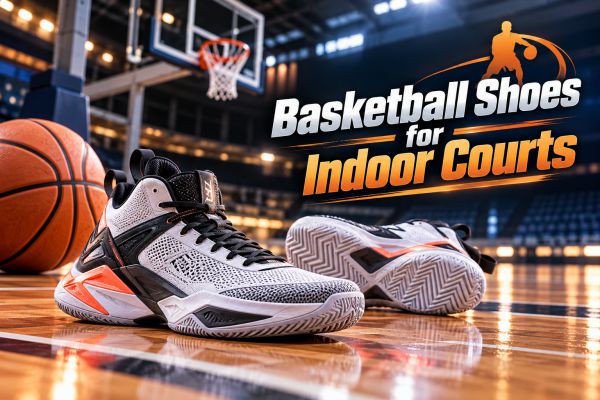
Basketball shoes for indoor courts
Key technical features that drive indoor court performance
Before selecting your next pair of indoor basketball shoes, evaluate the model against these four essential performance elements:
- Sticky, pliable rubber compounds: Indoor outsoles can afford to use softer, tackier rubber formulations that flex easily into the microscopic grooves of a wooden floor. These compounds deliver an instant “squeak” and biting grip that rigid outdoor rubber simply cannot replicate.
- Multidirectional traction design:Herringbone, radial, and computer-mapped generative tread patterns provide consistent bite regardless of which direction you plant your foot. Wide, pliable grooves shed surface dust more effectively during aggressive lateral stops.
- Responsive, energy-returning cushioning: Because hardwood provides mild impact relief, indoor players benefit most from lively cushioning setups—such as full-length Zoom Strobel, supercritical nitrogen foams (like Li-Ning Boom or Puma Nitro), or responsive dual-density air units—that absorb force and immediately bounce back to propel your next movement.
- Rigid midfoot shanks and lateral outriggers: To prevent foot twisting during high-speed direction changes, an indoor shoe must feature a rigid midfoot shank plate made of TPU or carbon fiber. An extended lateral outrigger near the pinky toe acts as an essential stabilizer, preventing ankle roll during sharp cuts.
Shoe profiles tailored to different indoor playing styles
Not every player requires the same setup on hardwood. Matching your choice to your position and movement profile ensures optimal results when searching for the best basketball shoes for indoor courts:
For quick guards and perimeter slashers (Court feel & instantaneous grip)
- Focus: Ultra-lightweight builds, low-to-the-ground midsoles, aggressive traction bite.
- Top Shoe Profiles: Low-profile speed models—such as the Li-Ning Gamma / Way of Wade 808 line, Nike Sabrina series, or adidas Harden Vol. series—offer razor-sharp court feel and sticky traction designed for explosive direction changes.
For versatile scorers and wings (Balanced cushion & springy response)
- Focus: Responsive forefoot bounce, smooth heel-to-toe transitions, medium-height collar support.
- Top Shoe Profiles: Flagship performers like the Air Jordan main line, Nike KD series, or Way of Wade main line combine lively full-length Zoom or supercritical foam setups with supreme lockdown for all-around playmaking.
For interior players and heavy jumpers (Maximum impact absorption & stability)
- Focus: Thick impact cushioning stacks, broad outsole footprints, rigid heel counters.
- Top Shoe Profiles: Protective setups like the Nike LeBron series, New Balance Fresh Foam BB line, or 361° Joker series provide heavy shock absorption and structural containment for players landing heavily in the key.
Indoor outsole maintenance and dust management on the court
Maintaining elite traction throughout a four-quarter game requires proper habits and care:
- Master the active court wipe:During play, dust naturally adheres to pliable rubber outsoles. Habitually wiping the bottom of your shoes with a moist hand during breaks or free-throw routines clears fine particles from the tread grooves, restoring full stopping power.
- Store footwear in temperature-controlled environments: Avoid leaving your indoor basketball shoes in a hot car trunk or cold garage. Extreme temperature fluctuations harden soft rubber compounds, permanently stripping away their sticky tactile grip and shortening their performance lifespan.
- Keep your indoor shoes off the street: Never wear your indoor performance shoes outdoors, even for a brief walk from the parking lot to the gym. Rough asphalt acts like a rasp on soft indoor rubber compounds and embeds jagged dirt particles deep into the traction grooves, ruining their effectiveness on hardwood.
Summary
Playing on polished indoor courts gives you access to the highest-performing basketball footwear technologies available. Prioritize sticky rubber compounds, responsive energy-returning cushioning, and strong midfoot shanks over purely cosmetic appeal. Selecting footwear built specifically for your playing style and indoor surface conditions will keep your footwork precise, your jumps explosive, and your joints protected every time you step onto the court.
Related Posts
Basketball Shoes For Outdoor Basketball: Protecting Your Joints And Your Footwear
Selecting the best basketball shoes for outdoor basketball requires a completely different mindset than shopping for an indoor pair. While playing on polished hardwood provides natural shock absorption and preserves soft rubber outsoles, outdoor streetball courts act like sandpaper on your footwear while exerting harsh, unrelenting forces on your joints. Many players make the mistake […]
Basketball Shoes For Centers: Balancing Impact Cushioning And Court Stability
Finding the best basketball shoes for centers is one of the most critical footwear decisions a big man can make. While lightweight guards thrive on thin midsoles and razor-sharp court feel, centers operate in a high-impact zone dominated by physical post-up battles, heavy screen setting, violent box-outs, and intense landing impacts after contested rebounds. When […]
Basketball Shoes for Guards: What Matters Most on the Court?
Playing guard in basketball requires constant movement, quick reactions, and precise control. Whether you handle the ball as a point guard or create scoring opportunities as a shooting guard, your shoes influence how confidently you move on the court. Every acceleration, sudden stop, crossover, and defensive slide places different demands on your footwear. However, choosing […]

[Top-Rated] The Best Basketball Shoes For Ankle Support 2025
When participating in basketball competitions, the occurrence of injuries is widespread. To avoid those problems, you need the best basketball shoes for ankle support. There are many types of basketball shoes on the market. However, when it comes to ankle support, not all shoes are created equal. In this article, Scott Fujita will guide you […]