





When basketball double dribble explained is what you need to understand court violations, seeing a referee blow the whistle and pat their hands alternately up and down can leave new fans and players confused. Ball control is the core mechanic of basketball offense, and strict regulations dictate how a player can handle the basketball while moving across the floor. Double dribble is one of the most fundamental violations called in basketball, yet it often catches players off guard during fast-paced play. Understanding what constitutes a double dribble, how it differs from other ball-handling infractions, and how to maintain legal possession will help you follow the game with clarity and improve your performance on the hardwood.
Understanding the mechanics of a double dribble violation
In basketball, dribbling is defined as continuously bouncing the ball against the floor with one hand. A double dribble violation occurs when a player breaks the continuous rhythm of dribbling in specific illegal ways. Like other court violations, a double dribble does not award free throws to the opponent; instead, it results in an immediate turnover, giving possession to the opposing team at the nearest sideline or baseline.
Stopping and restarting a dribble
The most basic form of a double dribble happens when a player comes to a complete stop in their dribbling motion and then decides to start bouncing the ball again.
- Ending the dribble: A player legally ends their dribble the moment they bring two hands onto the ball simultaneously, or allow the ball to come to rest in one or both hands.
- The illegal restart: Once a player has gathered or rested the ball in their hands, they are legally required to either pass the ball to a teammate or attempt a shot. If they push the ball back down to the floor to begin dribbling a second time, the referee will instantly blow the whistle for a double dribble.
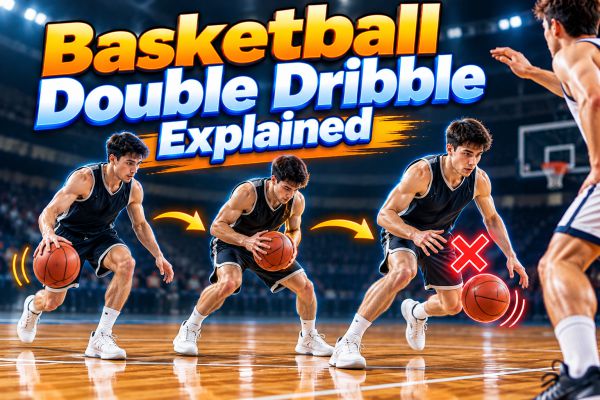
Basketball double dribble explained
Dribbling with both hands at the same time
Proper dribbling technique requires a player to bounce the ball using one hand at a time, alternating between left and right as needed.
- Two-handed touches: If a player uses both hands at the exact same moment to push the ball down onto the floor, it is an immediate double dribble violation.
- Control and rhythm: While players frequently switch the ball from hand to hand during crossovers, the ball must only contact one hand at a time throughout the entire move.
The difference between double dribbling and carrying
It is common for viewers to confuse a double dribble with a carrying (or palming) violation, as both involve illegal ball-handling mechanics.
- Carrying (Palming): A carry occurs when a player puts their hand underneath the ball while dribbling, pausing its downward motion, and then continues dribbling. The dribble technically never stopped with two hands, but the hand position was illegal.
- Double Dribble: A double dribble explicitly requires the player to completely terminate the dribble (by holding it with two hands or resting it) and then intentionally start a second dribble sequence. Both infractions lead to the same result: a turnover and loss of possession.
Legal exceptions and accidental ball touches
Not every multi-touch scenario results in a double dribble whistle. Referees distinguish between intentional ball control and accidental contact.
- Fumbled catches and loose balls: If a player receives a pass or tries to catch a loose ball and accidentally fumbles or drops it before gaining secure control, picking the ball up and beginning a dribble is entirely legal.
- Defensive deflections: If a defender swats at or touches the ball while an offensive player is holding it after a completed dribble, the offensive player may legally pick up the loose ball and begin a brand-new dribble sequence.
Conclusion
Having basketball double dribble explained clearly strips away the confusion surrounding ball-handling regulations. Maintaining a legal dribble comes down to simple principles: use one hand at a time, keep your hand on top of the ball, and commit to passing or shooting once you bring both hands together. Whether you are analyzing backcourt plays on television or sharpening your dribbling drills on the court, mastering these foundational rules keeps your offense smooth, efficient, and turnover-free.
Related Posts
Basketball Traveling Explained: A Simple Rule Breakdown
When basketball traveling explained is what you need to make sense of court action, seeing a referee suddenly stop a fast break to roll their hands over each other can leave both players and fans scratching their heads. Traveling is one of the most frequently called violations in basketball, yet it remains one of the […]
Basketball Fouls Explained: A Simple Court Guide
When basketball fouls explained is what you need to make sense of a game, watching the referee suddenly blow the whistle and make dramatic hand signals can feel confusing. Players throw their hands up in protest, coaches shout from the sidelines, and free-throw shooting begins. Physical contact is an inevitable part of a fast-paced sport […]
NBA Positions Explained: The 5 On-Court Roles
When NBA positions explained is what you are looking for, turning on a professional game can sometimes feel overwhelming. Today’s high-flying NBA superstars constantly cross up defenders, shoot from deep beyond the arc, and run transition plays at lightning speed. Yet, underneath the highlight-reel dunks and tactical rotations, every team relies on a standard system […]
Basketball Rules Explained: A Beginner’s Guide
When you want basketball rules explained without wading through a dense rulebook, watching a fast-paced game on television can feel confusing. With players sprinting back and forth, the constant squeak of sneakers, and whistles blowing seemingly every minute, it is easy to feel lost. However, beneath the high-energy action, basketball is governed by a clear, […]