





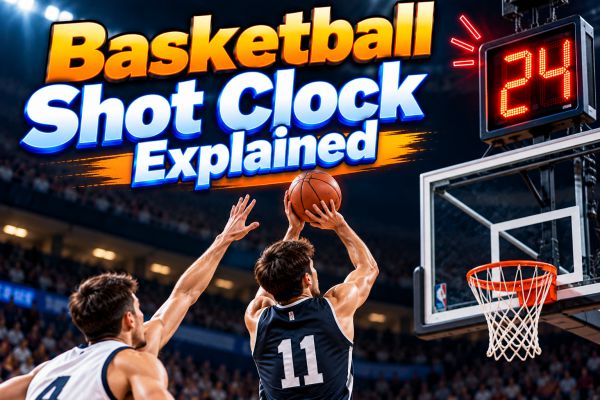
When basketball shot clock explained is what you need to keep up with the game, watching the small digital timer countdown above the backboard can add an extra layer of tension to every possession. The shot clock is one of the most important tactical elements in modern basketball, dictating the tempo of play and forcing teams to execute their offense efficiently. Before its introduction, teams could simply hold onto the ball indefinitely to protect a lead, making games slow and low-scoring. Understanding how the shot clock works, when it resets, and what happens when it runs out will give you a much clearer view of game strategy and clock management.
Understanding the mechanics of the shot clock
The shot clock is a dedicated timer designed to limit the amount of time an offensive team can possess the ball without attempting a shot. It ensures that basketball remains a fast-paced, high-scoring, and spectator-friendly sport across all professional and amateur leagues.
Standard shot clock duration and league variations
Different levels of basketball use slightly different shot clock durations, but the underlying purpose remains exactly the same across every rulebook.
- NBA and WNBA (24 Seconds): Professional leagues utilize a 24-second shot clock, forcing teams to move the ball rapidly and create scoring opportunities in under half a minute.
- FIBA and College Basketball (24 to 30 Seconds): International basketball (FIBA) also operates on a 24-second timer, while NCAA men’s and women’s college basketball currently use a 30-second shot clock to allow for longer offensive sets.
Shot clock reset rules during live play
The shot clock does not simply run continuously for 24 seconds on every possession; specific actions on the court will pause, reset, or adjust the timer.
- Hitting the rim: For a shot clock to fully reset to 24 seconds, the ball must leave the shooter’s hand before the horn sounds and make contact with the basket ring (rim). If the ball hits only the backboard or misses completely (an “airball”), the clock continues to run.
- Offensive rebounds (14-second rule): In many modern leagues, including the NBA and FIBA, if an offensive team grabs a rebound after a missed shot hits the rim, the shot clock resets to 14 seconds rather than a full 24 seconds to keep the pace of play brisk.
- Defensive fouls and kickballs: If a defender commits a foul or intentionally kicks the ball while the shot clock is under 14 seconds, the timer is reset to 14 seconds to give the offense adequate time to reorganize.
Basketball shot clock explained
Shot clock violations and court penalties
A shot clock violation occurs when the offensive team fails to make a legal shot attempt before the clock reaches zero.
- The signal and whistle: When the shot clock expires, a distinct horn sounds and the LED light strips around the backboard illuminate in red. Referees immediately blow the whistle to stop live play.
- The turnover penalty: A shot clock violation is treated as a turnover. The ball is awarded to the opposing team for an inbounds pass at the nearest spot on the sideline.
Strategic impact on late-game situations
Understanding the shot clock reveals why coaches and players make specific tactical decisions near the end of quarters or games.
- Managing the pace: Teams with a comfortable lead will intentionally run the shot clock down to its final seconds before taking a shot, effectively minimizing the opponent’s remaining possession time.
- Beating the buzzer: When the shot clock winds down below five seconds, offensive players are forced to take contested shots or execute quick “two-man” plays, creating high-pressure moments that often decide close games.
Conclusion
Having basketball shot clock explained clearly highlights how time management drives strategy on the hardwood. Far from being just a countdown timer, the shot clock is the heart of basketball’s fast rhythm, pushing teams to shoot, pass, and rebound under constant pressure. Recognizing how the shot clock operates allows you to anticipate desperate late-clock shots, understand tactical substitutions, and enjoy the suspense of every single possession.
Related Posts
Basketball Goaltending Explained: Simple Rim Rules
When basketball goaltending explained is what you need to understand key court rulings, seeing a referee blow the whistle and award points for a shot that never went through the hoop can seem confusing. Blocked shots are among the most thrilling plays in basketball, electrifying fans and shifting game momentum. However, there is a fine […]
Basketball Double Dribble Explained: A Simple Rule Guide
When basketball double dribble explained is what you need to understand court violations, seeing a referee blow the whistle and pat their hands alternately up and down can leave new fans and players confused. Ball control is the core mechanic of basketball offense, and strict regulations dictate how a player can handle the basketball while […]
Basketball Traveling Explained: A Simple Rule Breakdown
When basketball traveling explained is what you need to make sense of court action, seeing a referee suddenly stop a fast break to roll their hands over each other can leave both players and fans scratching their heads. Traveling is one of the most frequently called violations in basketball, yet it remains one of the […]
Basketball Fouls Explained: A Simple Court Guide
When basketball fouls explained is what you need to make sense of a game, watching the referee suddenly blow the whistle and make dramatic hand signals can feel confusing. Players throw their hands up in protest, coaches shout from the sidelines, and free-throw shooting begins. Physical contact is an inevitable part of a fast-paced sport […]