





When basketball goaltending explained is what you need to understand key court rulings, seeing a referee blow the whistle and award points for a shot that never went through the hoop can seem confusing. Blocked shots are among the most thrilling plays in basketball, electrifying fans and shifting game momentum. However, there is a fine line between a spectacular, legal defense and an illegal goaltending violation. Referees monitor the precise trajectory of the ball and its position relative to the rim to ensure shot contests remain fair. Understanding how goaltending works, how it differs from basket interference, and why points are awarded will help you read high-stakes defensive plays with ease.
Understanding the rules of goaltending and basket interference
Goaltending is a defensive or offensive violation that occurs when a player illegally alters the path of a shot while the ball is on its way toward the basket. The rule exists to prevent tall or athletic players from simply standing under the rim and swatting away every shot before it has a chance to drop in.
The downward flight and trajectory rule
The primary trigger for a goaltending call centers on the path of the basketball after it leaves the shooter’s hands.
- On the downward arc: A defender can legally block a shot as long as the ball is still traveling upward. The moment the ball reaches its apex and begins its downward trajectory toward the rim, touching it is an automatic goaltending violation.
- Above the ring level: For goaltending to be called on a downward shot, the ball must also be above the level of the ring and have a legitimate chance to score.
Backboard contact and rim interaction
The rules surrounding goaltending extend beyond the ball’s arc to include how the ball interacts with the backboard and rim.
- Off the glass: Once a shot contacts the backboard while entirely above the level of the rim, it is instantly protected. Even if the ball is still moving upward, a defender cannot touch it after it hits the backboard. Doing so results in an immediate goaltending call.
- Directly over the cylinder: Once the ball is directly above the rim within an imaginary cylinder extending upward, touching the ball—regardless of its direction—is illegal in NBA and college play.
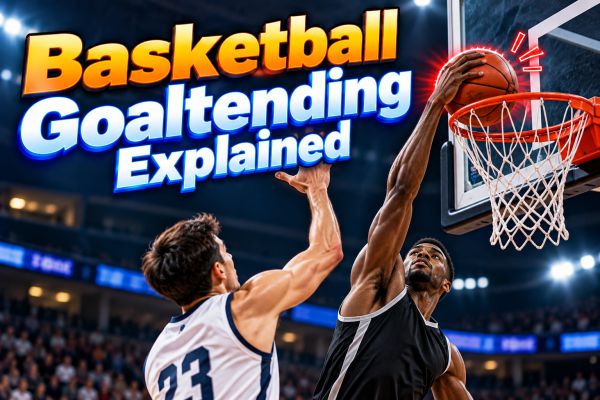
Basketball goaltending explained
Difference between goaltending and basket interference
While commentators often group these calls together, basket interference involves specific illegal actions touching the rim, net, or backboard itself.
- Goaltending: Refers specifically to illegally touching the ball while it is on its downward flight toward the basket or after it has touched the backboard above rim level.
- Basket interference: Occurs when a player touches the rim, net, or backboard while the ball is on or within the basket cylinder, or reaches through the bottom of the net to touch the ball. Dunking cleanly is allowed, but hanging on the rim to pull the net or shake the basket while a shot is live triggers an interference call.
Penalties and offensive vs. defensive goaltending
The consequences of a goaltending call depend entirely on which team commits the violation.
- Defensive goaltending: If a defender commits goaltending, play stops immediately and the offensive team is awarded the points as if the shot had gone in (two or three points, depending on where the shot was taken).
- Offensive goaltending: If an offensive player touches the ball on its downward arc or over the cylinder (often when attempting a put-back dunk too early), the basket is negated and possession is turned over to the defense.
Conclusion
Having basketball goaltending explained clearly clarifies one of the most crucial judgment calls made by referees. The boundary between a game-changing block and an illegal goaltend comes down to split-second timing: catching the ball on its upward flight versus touching it on its way down or off the backboard. Mastering these rules gives you a sharper perspective on rim protection, defensive strategy, and the fine margin between defensive brilliance and costly turnovers.
Related Posts
Basketball Double Dribble Explained: A Simple Rule Guide
When basketball double dribble explained is what you need to understand court violations, seeing a referee blow the whistle and pat their hands alternately up and down can leave new fans and players confused. Ball control is the core mechanic of basketball offense, and strict regulations dictate how a player can handle the basketball while […]
Basketball Traveling Explained: A Simple Rule Breakdown
When basketball traveling explained is what you need to make sense of court action, seeing a referee suddenly stop a fast break to roll their hands over each other can leave both players and fans scratching their heads. Traveling is one of the most frequently called violations in basketball, yet it remains one of the […]
Basketball Fouls Explained: A Simple Court Guide
When basketball fouls explained is what you need to make sense of a game, watching the referee suddenly blow the whistle and make dramatic hand signals can feel confusing. Players throw their hands up in protest, coaches shout from the sidelines, and free-throw shooting begins. Physical contact is an inevitable part of a fast-paced sport […]
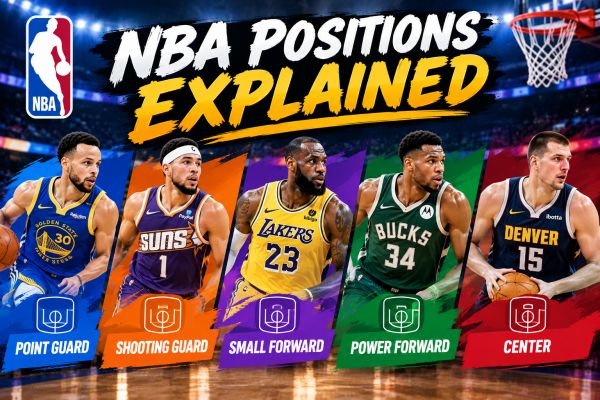
NBA Positions Explained: The 5 On-Court Roles
When NBA positions explained is what you are looking for, turning on a professional game can sometimes feel overwhelming. Today’s high-flying NBA superstars constantly cross up defenders, shoot from deep beyond the arc, and run transition plays at lightning speed. Yet, underneath the highlight-reel dunks and tactical rotations, every team relies on a standard system […]