




Selecting the right basketball shoes for youth players requires a carefully balanced approach that prioritizes joint protection, anatomical support, and practical value. Unlike adult athletes whose skeletal structures are fully matured, young players are going through active growth phases. Their bones, growth plates, and surrounding ligaments are particularly susceptible to repetitive impact stress and awkward landings.
Choosing improper footwear for a developing athlete can lead to chronic soreness, such as Sever’s disease (heel pain) or Osgood-Schlatter disease (knee inflammation). Furthermore, young players frequently switch between outdoor concrete schoolyards and indoor gym floors, demanding versatile durability from their gear.
To help parents and coaches safeguard young athletes while supporting their court development, this guide analyzes the biomechanics of growing feet, essential protective features, budget-smart footwear categories, and practical sizing strategies.
Developmental protection guide for young basketball athletes
Biomechanical hazards facing developing feet and growing joints
Young basketball players undergo unique physical stresses that demand specialized footwear engineering:
- Vulnerable growth plates: The growth plates in a young player’s heels (calcaneus) and knees (patellar tendon attachment) are softer than mature bone. High-impact landings on hard courts transmit forces that can cause inflammation if not properly cushioned.
- Developing ligament stability: Ankle ligaments in youth players are still gaining strength and coordination. Unstable shoes with narrow outsoles or weak heel counters increase the likelihood of awkward rolls during lateral movements.
- Rapid foot expansion: Growing feet change shape and size rapidly. Footwear that squeezes the forefoot can restrict natural toe splay, causing painful friction blisters, ingrown toenails, or midfoot cramping.
Structural features that safeguard young players on court
Before buying footwear for a junior athlete, evaluate prospective models against four non-negotiable protective criteria:
- Shock-absorbing foam cushioning
Prioritize midsoles that feature dense, forgiving foam compounds—such as adidas Bounce, Nike Renew/Cushlon, or Puma ProFoam. These setups absorb landing forces on hard concrete or hardwood without feeling unstable under lighter body weights. - Broad outsole bases with lateral outriggers
Preventing ankle rolls starts with a stable foundation. Look for shoes with a wide, flat outsole profile and a clear lateral outrigger near the pinky toe. This extended footprint acts as a kickstand during sudden side-to-side cuts. - Multi-directional, slip-resistant traction
Safety requires dependable grip. Deep herringbone or multidirectional radial tread patterns prevent dangerous slips on dusty school courts, giving young players the traction needed to stop and plant with confidence. - Structured heel lockdown and breathable uppers
A stiff internal heel counter cups the back of the foot, holding the heel securely over the midsole. Paired with flexible mesh or reinforced textile uppers, this setup keeps the foot locked down while allowing ventilation.
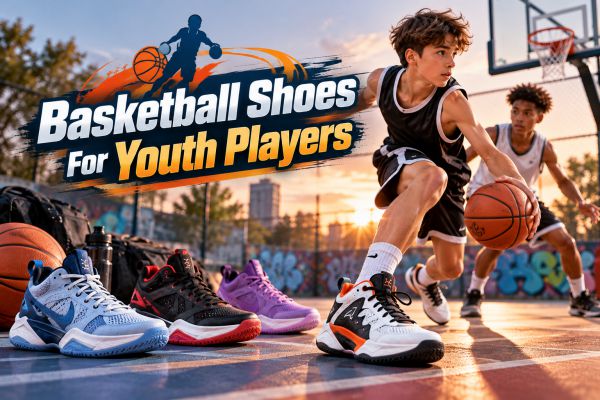
Basketball shoes for youth players
Matching shoe architectures to youth playing environments and budgets
When evaluating basketball shoes for youth players, align your purchase with the primary courts your child plays on and your financial expectations:
- For outdoor schoolyard and park play (High Durability & Rugged Traction)
- Focus: Thick solid rubber outsoles, abrasion-resistant toe caps, budget-friendly price points.
- Top Shoe Profiles: Durable youth models—such as the Nike Precision youth line, adidas Dame Certified series, or Li-Ning / Anta junior series—deliver tough rubber outsoles built to survive abrasive blacktop surfaces.
- For indoor club and team competition (Responsive Bounce & Elite Grip)
- Focus: Sticky rubber compounds, low-profile responsive cushioning, snug lockdown fit.
- Top Shoe Profiles: Performance-driven junior releases—like the Nike Sabrina / Giannis Immortality junior editions, Puma Triple youth, or Air Jordan takedown lines—offer excellent court feel and springy response for competitive team play.
- For versatile all-around usage (Joint Protection & Growth Adaptability)
- Focus: Extra midsole cushioning stacks, forgiving upper materials, adaptable lacing.
- Top Shoe Profiles: Protective all-rounders—such as the New Balance TWO WXY junior models or Nike Team Hustle series—provide a balanced mix of heel protection and roomier fits for growing feet.
Strategic sizing rules to manage fast foot growth without sacrificing safety
Managing sizing for young athletes requires balancing financial practicality with physical safety:
- The “rule of thumb” for growth room: When testing shoes with performance socks on, ensure there is roughly a thumb’s width (about 1 to 1.5 cm) of space between the child’s longest toe and the tip of the shoe. This allows room for natural foot expansion and growth without making the shoe dangerously loose.
- Avoid buying more than one full size up: Buying shoes two sizes too big so “they can grow into them” is a major safety hazard. Oversized shoes cause the foot to slide forward, leading to heel slip, toe bruising, and compromised lateral stability during games.
- Check for signs of outgrown footwear: Regularly inspect your child’s feet after practices. Red marks across the top of the foot, complaints of toe cramping, or compressed heel material indicate that the foot has outgrown the shoe and requires immediate replacement.
Summary
Protecting young athletes on the basketball court comes down to selecting footwear engineered for stability, shock absorption, and proper anatomical fit. Prioritize wide stable outsoles, supportive foam cushioning, and durable rubber traction over expensive celebrity trends. Investing in shoes built for young players’ physical development will safeguard their joints, prevent painful growth complications, and keep them enjoying the game safely.
Related Posts
How To Choose Basketball Shoes For Quick Guards
Understanding how to choose basketball shoes for quick guards is one of the most effective ways to upgrade your court agility and responsiveness. Point guards and shooting guards rely on rapid acceleration, sharp crossovers, and sudden deceleration to create space and beat defenders. When you wear footwear with an overly thick midsole or sloppy internal […]
Basketball Shoes For Jumping: Protection & Bounce
Finding the best basketball shoes for jumping is essential for players looking to maximize their vertical bounce, elevate explosively for rebounds, and protect their joints upon landing. Jumping is one of the most mechanically demanding actions on a basketball court, requiring an optimal balance between energy return, forefoot flexibility, and heavy shock absorption. Wearing footwear […]
Basketball Shoes For Wide Feet: Maximum Comfort And Lockdown
Finding the best basketball shoes for wide feet is often an exhausting trial-and-error process for players who struggle with standard retail models. Most modern performance basketball shoes are built on narrow lasts derived from professional player profiles, leaving wide-footed players to deal with severe midfoot pinching, painful lateral blowouts, bruised pinky toes, and restricted blood […]
Basketball Shoes For Ankle Support: Lockdown & Grip
Searching for the best basketball shoes for ankle support is a top priority for players dealing with previous ankle sprains, weak ligaments, or the fear of landing awkwardly on another player’s foot. Ankle injuries represent the most common trauma in basketball, often sidelining players for weeks or resulting in chronic instability if not protected properly. […]