




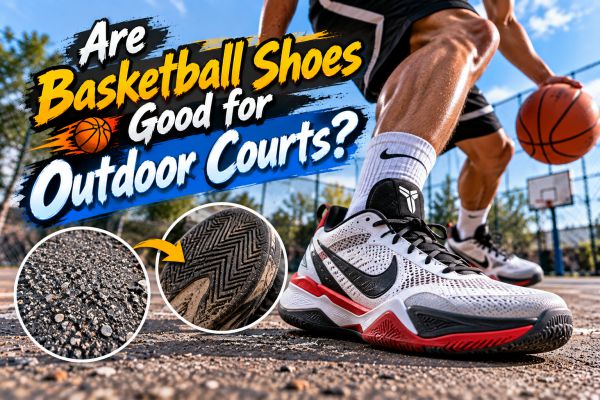
If you are asking yourself, “Are Basketball Shoes Good for Outdoor Courts?“, the short answer is yes—but with several important caveats. While basketball shoes are fundamentally designed to handle the intense lateral movements, rapid accelerations, high-impact jump landings, and sudden stops inherent to the game, not all basketball shoes are built to survive the harsh environment of the blacktop. Using a premium shoe engineered strictly for indoor hardwood on a rough asphalt surface can quickly ruin its tread, shred the upper, and lead to premature wear.
In this comprehensive guide, we will break down whether basketball shoes are good for outdoor courts, what key features make a shoe streetball-ready, and how to pick the right pair for your local outdoor pickup games.
Detailed performance review: Are basketball shoes good for outdoor courts?
To determine if a specific pair of basketball shoes will perform well and last on outdoor courts, let’s examine how court conditions affect outsole rubber, cushioning systems, upper construction, and overall value.
Which basketball shoes are built for outdoor surfaces?
Understanding the critical differences between indoor-focused and outdoor-ready basketball shoes is the key to protecting both your footwear investment and your joints.
- Outdoor-Ready Basketball Shoes: These models are specifically constructed with dense, high-abrasion rubber outsoles (often tagged with XDR, Extra Durable Rubber, or specialized outdoor compounds), deep and thick tread patterns, and reinforced uppers. They thrive on rough concrete, unpainted asphalt, and outdoor acrylic courts, maintaining grip and structural integrity despite constant friction.
- Indoor-Focused Basketball Shoes: Engineered strictly for pristine indoor hardwood floors, these shoes feature soft, pliable translucent or thin solid rubber outsoles with shallow, intricate traction grooves. When exposed to outdoor asphalt, the surface acts like a “cheese grater,” wearing down the tread within weeks and destroying the shoe’s grip.
Are Basketball Shoes Good for Outdoor Courts?
Key evaluation of outdoor cushioning and traction
Playing on unyielding concrete places drastically different physical demands on your footwear compared to sprung wood gym floors.
- Cushioning Requirements:
- Outdoor concrete courts offer zero natural shock absorption. As a result, basketball shoes used outdoors require robust, resilient cushioning setups (such as thick EVA, dual-density foam, or resilient air units) to absorb impact and protect your knees, ankles, and lower back during heavy landings.
- Ultra-thin or overly minimal “court feel” midsoles that feel crisp indoors may lead to joint fatigue and soreness when played extensively on blacktop.
- Traction Performance:
- Outdoor courts accumulate dust, dirt, and loose grit. Outdoor-ready basketball shoes utilize wide, deep traction grooves (such as classic thick herringbone) that push debris aside rather than letting dirt clog narrow channels.
- Harder rubber compounds prevent the tread pattern from bending or warping under aggressive lateral cuts on high-friction outdoor surfaces.
Upper durability and surface longevity
Beyond the sole, the upper material dictates how well the shoe survives toe drags, scrapes, and aggressive outdoor play.
- Upper Materials:
- Outdoor streetball demands durable uppers made from thick mesh, synthetic leather, reinforced canvas, or fuse overlays around high-wear zones like the toe box.
- Ultra-lightweight knit or paper-thin monofilament mesh uppers—popular on indoor guard shoes—can tear or fray quickly when scuffed against rough concrete or asphalt.
- Cost vs. Longevity:
- Because outdoor courts naturally shorten the lifespan of any sneaker, opting for budget-friendly or mid-tier basketball shoes with heavy-duty outsoles often provides far better long-term value than wearing expensive top-of-the-line signature models meant for indoor hardwood.
Conclusion
So, are basketball shoes good for outdoor courts? Yes, basketball shoes remain the absolute best footwear choice for outdoor play compared to running shoes or cross-trainers because they deliver the mandatory lateral containment, ankle stability, and court traction required for the sport. However, they are only good for outdoor courts if you select models specifically engineered with hard, durable rubber outsoles, deep tread patterns, and thick, impact-absorbing cushioning. By choosing a shoe built to withstand the abrasive nature of asphalt, you get maximum performance, essential joint protection, and long-lasting durability on every streetball run.
Related Posts
Are Ja Morant Shoes Good? On-Court Performance Review
If you are wondering, “Are Ja Morant Shoes Good?“, you are not alone. As one of Nike’s most popular signature basketball lines, Ja Morant’s signature sneakers (such as the Ja 1 and Ja 2) have gained massive attention for their eye-catching colorways, accessible price point, and direct connection to one of the NBA’s most electrifying […]
Basketball Shoes vs Training Shoes: Which One Do You Need?
Choosing between Indoor vs Outdoor Basketball Shoes is one of the most critical decisions a hooper can make when buying a new pair of kicks. While both types of basketball shoes may look nearly identical on the shelf, they are engineered with vastly different rubber compounds, outsole patterns, and upper materials. Wearing an indoor shoe […]
Basketball Shoes vs Training Shoes: Which One Do You Need?
Choosing between Basketball Shoes vs Training Shoes is a common point of confusion for athletes and gym-goers alike. At first glance, both sneaker categories appear to offer supportive uppers, cushioned midsoles, and durable outsoles designed for athletic movements. However, basketball shoes and cross-training shoes are engineered for entirely different physical demands, biomechanics, and surface interactions. […]
Nike GT Cut vs Nike Sabrina: How Do They Perform On Court?
Choosing between Nike GT Cut vs Nike Sabrina is a common dilemma for basketball players searching for the ultimate low-cut performance sneaker. Both signature and performance lines from Nike are built specifically with quick, agile hoopers in mind, offering exceptional court feel, lightweight support, and top-tier traction. However, while both shoes share a focus on […]