





When basketball man-to-man defense explained becomes your focus for decoding professional and amateur game strategies, you dive into the heartbeat of competitive basketball. Unlike zone defenses that protect static spatial regions on the hardwood, man-to-man defense is built on absolute individual accountability fused with synchronized team coordination. Every single defender is handed a direct assignment: locate, disrupt, and shut down their designated opponent from tip-off to the final buzzer.
Building a suffocating man-to-man scheme requires rigorous discipline, elite communication, and precise geometry. Below is a comprehensive tactical blueprint breaking down how this foundational defensive framework operates, how players manage complex screening action, and why it remains the gold standard of basketball defense.
Mastering the Mechanics and Tactics of Man-to-Man Defense
The foundational pillars of individual assignment
At its simplest level, playing effective man-to-man defense starts long before an offensive player receives the basketball. It requires mastering personal posture, spatial awareness, and constant adjustment based on proximity to the basket.
- The stance and posture: Defenders must stay low with knees bent, a wide base, and hands active to contest passing lanes and ball movement. Standing upright or flat-footed makes it impossible to react to sudden crossover dribbles or explosive first steps.
- The ball-you-man triangle: Every off-ball defender must cultivate court vision by seeing both their assigned man and the basketball simultaneously, allowing them to step into passing lanes or offer immediate interior support.
- Denying the strong-side vs. weak-side: Defenders closest to the ball apply high-pressure denial, while defenders on the opposite side sink deeper into the paint to safeguard high-value scoring areas.
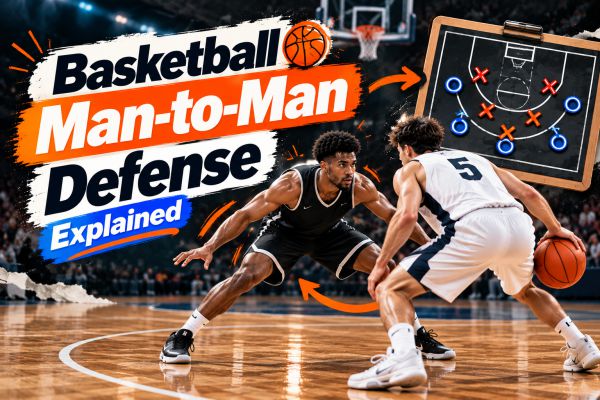
Basketball man-to-man defense explained
Navigating the chaos of screens and off-ball movement
Offensive teams rarely stand still; they use constant screening, backdoor cuts, and give-and-go passes to break down single coverage. How a defense handles these disruptions dictates whether they get a stop or give up an easy basket.
- Communication cues: Shouting “Switch!” when two defenders cannot fight through a screen, or calling “Over / Under!” to instruct teammates on how to bypass the physical barrier.
- Fighting through screens: The preferred method against elite shooters is sliding through the narrow gap between screener and teammate to maintain original matchups.
- Recovery sprints: When communication breaks down, defenders execute high-speed recovery sprints, closing out with high hands to contest jump shots without fouling.
The anatomy of help defense and rotation
A common misconception is that man-to-man defense is five isolated 1-on-1 matches happening simultaneously. In reality, modern defenses function as a single connected organism.
- The primary stopper: The player guarding the ball handler bears the initial burden of slowing down penetration, forcing the ball toward the sideline or baseline.
- Stepping into position: When penetration happens, the nearest help defender steps over to establish legal guarding position, drawing a charging foul or forcing a panicked pass.
- The chain reaction rotation: When one defender leaves their man to help, the remaining off-ball defenders shift one step closer to cover the next open passing option.
Comparing man-to-man to zone systems
Understanding why coaches alternate between defensive schemes highlights the unique psychological and physical demands of man-to-man play.
- High accountability: In man-to-man, mental lapses or missed box-outs point directly to a single player, making defensive discipline a strict requirement.
- Matchup versatility: Coaches can hide a slower player or assign an elite perimeter lockdown defender to chase the opposing team’s star player across every square inch of the court.
- Physical toll: Man-to-man demands exhausting stamina because defenders must navigate endless screens and maintain high-intensity contact for entire quarters.
Conclusion
Having basketball man-to-man defense explained through its core rules, communication frameworks, and rotational systems exposes the immense effort required to achieve a defensive stop. It is a chess match played at lightning speed, where individual pride meets collective teamwork. Whether you are coaching a youth team, playing in a weekend pickup game, or analyzing professional tactics from home, mastering man-to-man principles allows you to appreciate the hard work, grit, and discipline driving every successful defensive possession.
Related Posts
Basketball Zone Defense Explained: Rules & Setups
When basketball zone defense explained is what you need to understand tactical game shifts, watching a coach suddenly call out a zone can completely change the rhythm of a match. Unlike traditional man-to-man defense where every player is locked onto a specific opponent, a zone defense treats the court as a grid of protected territories. […]

Basketball Pick and Roll Explained: The Ultimate Tactical Guide
When basketball pick and roll explained is what you are searching for, viewing it purely as a two-man drill on paper misses what actually makes it work. On the court, a pick and roll is not a set play with a guaranteed outcome; it is a dynamic reaction to how the defense responds. Whether you […]
Basketball Shot Clock Explained: Simple Rules & Timing
When basketball shot clock explained is what you need to keep up with the game, watching the small digital timer countdown above the backboard can add an extra layer of tension to every possession. The shot clock is one of the most important tactical elements in modern basketball, dictating the tempo of play and forcing […]
Basketball Goaltending Explained: Simple Rim Rules
When basketball goaltending explained is what you need to understand key court rulings, seeing a referee blow the whistle and award points for a shot that never went through the hoop can seem confusing. Blocked shots are among the most thrilling plays in basketball, electrifying fans and shifting game momentum. However, there is a fine […]