



Basketball Shoes For Forwards: How To Balance Impact Protection And Agility On Court

Finding the right pair of basketball shoes as a forward often feels like a constant compromise. Unlike guards who prioritize minimal weight and razor-thin court feel, or centers who need maximum bulk and heavy-duty structure, forwards operate in a demanding middle ground.
Whether you play as a versatile Small Forward (SF) attacking off the wing or a Power Forward (PF) battling in the paint, your footwear must support a violent mix of explosive linear drives, lateral slides, high-impact rebounding landings, and physical post play. Wearing the wrong pair can quickly lead to foot fatigue, rolled ankles, or nagging knee pain.
To help you navigate your options, this guide breaks down the physical demands of the forward position, the essential technical features to look for, targeted performance recommendations, and practical tips on fit and court durability.
Finding the right basketball shoes for forwards: a complete selection guide
Understanding the unique on-court demands of small and power forwards
The modern forward is no longer defined by a single static role. On any given possession, a forward might sprint the floor on a fast break, absorb contact near the rim, set a hard screen, or slide laterally to contest a guard on the perimeter. This versatility creates a complex dynamic for your feet and joints:
- High-Impact Landings: Competing for rebounds and elevated finish attempts means repeatedly landing with full body weight—often on one foot or in traffic. Without adequate force dispersion, these impacts transmit directly up to your knees, hips, and lower back.
- Multi-Directional Force: Forwards require strong lateral containment. When planting hard to alter direction or hold ground in the post, your foot exerts massive force against the sides of the shoe.
- Speed vs. Power Balance: A shoe that is overly stiff or heavily cushioned slows down your first step, while a shoe that is too stripped-down lacks the torsional stability and shock absorption required for physical interior play.
Understanding where your specific game falls on this spectrum is the first step toward selecting a shoe that protects your body without sacrificing your mobility.
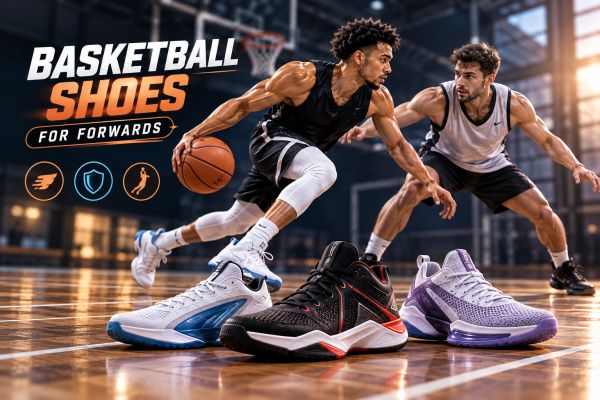
Basketball shoes for forwards
Essential shoe features every forward needs before buying
Before looking at specific models, it is vital to evaluate basketball shoes through four core mechanical pillars that directly impact a forward’s performance and longevity:
- Impact cushioning & energy return: Look for dual-density or full-length responsive foam setups paired with air-based or nitrogen-infused units (such as Nike Zoom Air or Puma Nitro). Forwards need enough thickness under the heel and midfoot to absorb heavy landings, but sufficient firmness in the forefoot so the shoe doesn’t feel sluggish during quick jump-offs.
- Torsional rigidity and lateral support: Torsional rigidity prevents the shoe from twisting unnaturally during hard plants. Look for shoes built with an internal or external midfoot shank (usually made of TPU or carbon fiber). Additionally, an outrigger—a slight extension of the outsole on the lateral forefoot—acts as an outrigger flare, keeping your foot stable during sharp lateral cuts.
- Lockdown and ankle containment: Ankle height (low, mid, or high) is largely a matter of personal preference, but lockdown is non-negotiable. A deep heel cup, padded internal Achilles pillows, and webbed lacing systems ensure your foot stays locked down onto the footbed. This eliminates heel slip and prevents your toes from jamming into the front of the shoe when stopping abruptly.
- Traction pattern and base width: A wider outsole base provides a stable platform for post moves and rebounding. For traction, traditional or modified herringbone patterns generally offer the most reliable multi-directional bite across varying court conditions.
Top performance shoe recommendations tailored to different forward styles
Rather than relying on a generic top list, consider these options matched to distinct playing styles:
For agile wings & slashers (speed & versatility)
- Focus: Lightweight containment, responsive forefoot transition, and flexible uppers.
- Top Profiles: Shoes like the Nike Lebron 21 / NXXT Gen series or the Jordan Tatum line offer a smooth heel-to-toe transition with low-profile responsive cushioning, ideal for players who face up, drive from the perimeter, and rely on quick first steps.
For heavy-impact & post-dominant forwards (power & protection)
- Focus: Maximum impact absorption, rigid shank plates, and heavy-duty lateral support.
- Top Profiles: Models like the Nike LeBron main line or adidas Zion series feature robust cushioning setups engineered specifically for heavier players who frequently absorb contact in the key and require maximum shock absorption on landing.
For all-around versatility & joint relief (balanced performance)
- Focus: Balanced foam-and-air cushioning, supportive midtop cuts, and anatomical lockdown.
- Top Profiles: The KD (Kevin Durant) series or adidas AE 1 / Harden line provide exceptional full-length cushioning and stability, making them go-to choices for forwards who do a little bit of everything on the court.
Fit, sizing, and court surface considerations for long-term comfort
Even the most technologically advanced basketball shoe will fail on court if the fit or outsole compound does not match your specific environment.
- Managing foot shapes (Wide vs. Narrow Feet): Many modern performance models are built on narrower lasts. If you have wide feet or flat arches, look for models with roomier toe boxes or performance brands known for wider fits (such as select Puma or Asics models). Always test shoes while wearing the actual performance socks or ankle braces you use during games.
- Sizing rules of thumb: Ensure you have roughly a thumb’s width of space between your longest toe and the end of the shoe when standing. Your foot expands naturally as blood flow increases during play; buying a shoe that feels skin-tight in the store can lead to bruised toenails and restricted circulation mid-game.
- Indoor vs. Outdoor durability: If you play primarily on outdoor asphalt or concrete courts, pay close attention to the rubber compound of the outsole. Soft, translucent rubber grips exceptionally well on clean indoor wood courts but degrades rapidly on abrasive outdoor surfaces. For outdoor play, opt for shoes with thick, solid rubber outsoles or specialized high-abrasion rubber (XDR) to ensure your investment lasts through the season.
Summary
As a forward, your footwear choices directly affect both your immediate court performance and your long-term joint health. Prioritize a wide, stable outsole base, reliable lockdown, and responsive impact protection over cosmetic hype. By matching your shoe’s mechanical strengths to your personal body weight and playing style, you can step onto the court confident in your stability, safety, and mobility.
Related Posts
Basketball Shoes For Centers: Balancing Impact Cushioning And Court Stability
Finding the best basketball shoes for centers is one of the most critical footwear decisions a big man can make. While lightweight guards thrive on thin midsoles and razor-sharp court feel, centers operate in a high-impact zone dominated by physical post-up battles, heavy screen setting, violent box-outs, and intense landing impacts after contested rebounds. When […]
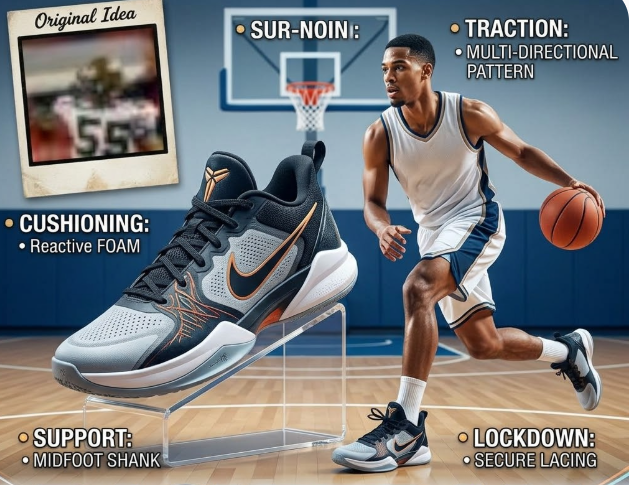
Basketball Shoes for Guards: What Matters Most on the Court?
Playing guard in basketball requires constant movement, quick reactions, and precise control. Whether you handle the ball as a point guard or create scoring opportunities as a shooting guard, your shoes influence how confidently you move on the court. Every acceleration, sudden stop, crossover, and defensive slide places different demands on your footwear. However, choosing […]

[Top-Rated] The Best Basketball Shoes For Ankle Support 2025
When participating in basketball competitions, the occurrence of injuries is widespread. To avoid those problems, you need the best basketball shoes for ankle support. There are many types of basketball shoes on the market. However, when it comes to ankle support, not all shoes are created equal. In this article, Scott Fujita will guide you […]

Spalding TF-1000 Classic Review: Is It The Best Basketball?
The Spalding TF 1000 Classic is the legendary indoor basketball for those who grew up with basketball in their memory. The image of this ball is associated with the NBA tournament. It has been an icon of basketball for a long time. Time flies, and things aren’t as they used to be, and at some […]